Elastic Security detection to host investigation
An Elastic Security detection brings signed host evidence in 12 seconds, and Claude pieces together a planted foothold with no shell access.
The scenario
Two identical web servers, web-1 and web-2, and a database host labelled as holding card data ran in AWS, with Auditbeat sending file, user and process events to Elasticsearch. We planted a harmless stand-in for an attacker's foothold on web-1: a local user with an SSH key, a script in a hidden directory, and a systemd timer that runs the script as root every two minutes.
The alert
An Elastic Security detection rule for new scheduled tasks, services and SSH keys raised four alerts on web-1. Its action posts each run's alerts to the Secronyx alert bridge through Kibana's Webhook connector, with a key that can post alerts and nothing else.
At a glance
The detection rule raises four alerts on web-1
Kibana's Webhook connector sends them to the Secronyx alert bridge
The bridge runs a persistence-sweep playbook of 9 read-only checks
web-1 signs every result within twelve seconds; they are saved as evidence
Claude follows up with Kibana and Secronyx, comparing web-1 with web-2
Claude reports a likely compromise and changes nothing
What Secronyx gathered, and how it was restricted
What it gathered from the host
- Local users: the new account, its UID, its admin rights and any recorded logins
- File details for the hidden script: path, size, hash and whether a package owns it
- Systemd timers and services, including what runs, as whom and how often
- Remote execution activity visible on the host
- The same checks on the twin host, for comparison
How it was restricted
- Read-only checks: no check returns file contents, and none changes the host
- Auth logs and sudoers need a scope this policy does not give the AI, so Claude could not read them
- A label policy decides what each caller may see; the card-data host is reserved for the security team
- Each host checks a single-use pass signed by the commander and writes every call to its own tamper-evident audit log
- Claude had two tools only, Kibana's MCP server with a read-only key and the commander: no shell and no file access
What the AI concluded
Claude's verdict was likely compromise on web-1. It named the new user, the hidden script and the timer running it as root every two minutes, noted that the only remote execution it could see was AWS Systems Manager Run Command, and found that web-2 has no such script or timer. It also spotted our rehearsal and the clean-up from an earlier demo, and proposed preserving evidence and containing web-1 before removing anything.
The proof
Figures from the recorded run, as reported in the walkthrough.
12 s
from the alert reaching the bridge to signed host evidence
33 calls
made by Claude: 25 to Secronyx and 8 to Kibana
20 of 20
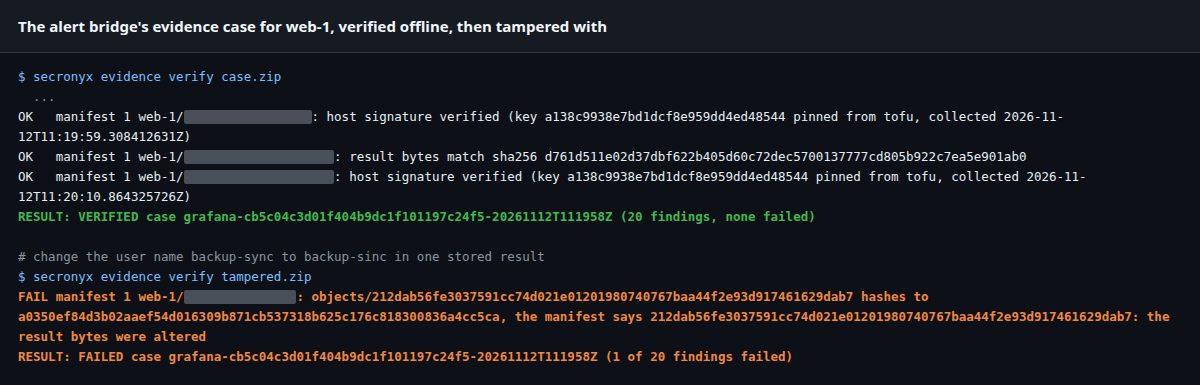
signed findings verified offline; changing one letter makes verification fail
0 calls
reached the card-data host
See every step
The walkthrough has the setup, the full story with screenshots, the evidence and how to run it yourself.
Product names belong to their owners and are used only to say what each demo connects to. Secronyx is not affiliated with, sponsored or endorsed by them.