InfluxDB
See whether InfluxDB 2 is up and which version runs, which buckets exist with what retention, and which tasks failed on their last run and why, with a token that only reads buckets and tasks. This plugin is in the next Secronyx release; the current download does not include it yet.
What it answers
Questions an on-call engineer asks, which an AI client can answer with this plugin.
- Is InfluxDB up and ready for queries and writes, and which version is running?
- Which buckets exist, and what is each one's retention period?
- Which tasks failed on their last run, and with what error?
- When did the failing downsampling task last finish?
What it returns
Each of the plugin's read-only tools, described in words.
- InfluxDB server health in one row - status (pass or fail), the health message, version and build commit
- InfluxDB buckets the token can see - name, ID, organization, type (user or system), retention and shard group duration in seconds (0 keeps data forever) and when created and last changed
- InfluxDB tasks whose last run failed - name, ID, organization, status (active or inactive), schedule, when the last run finished and its normalised error; never the Flux script
At a glance
- Plugin
- influxdb 1.0.0
- Publisher
- levantar
- Platforms
- Linux, Windows, macOS
Tested on
- InfluxDB 2.7.12 on Linux (Ubuntu 24.04, Docker), test lab
- InfluxDB 2.7.11 on macOS 15 (Intel, official release), test lab
- InfluxDB 2.7.11 on Windows Server 2022 (official release), test lab
How it logs in
Without an explicit choice, install tries the methods that need no secret first, in this order.
- A bearer token
The least-privilege login
The setup file in the pack. secronyx plugin setup influxdb prints it; an administrator applies it by hand.
See it run
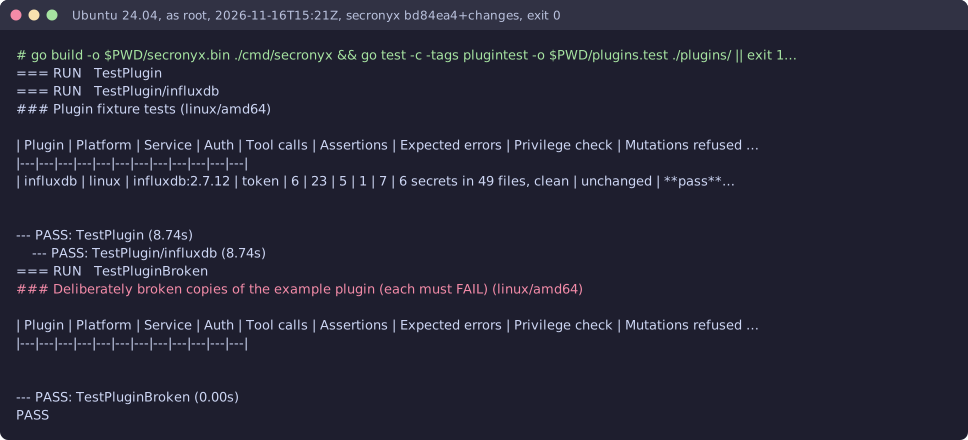
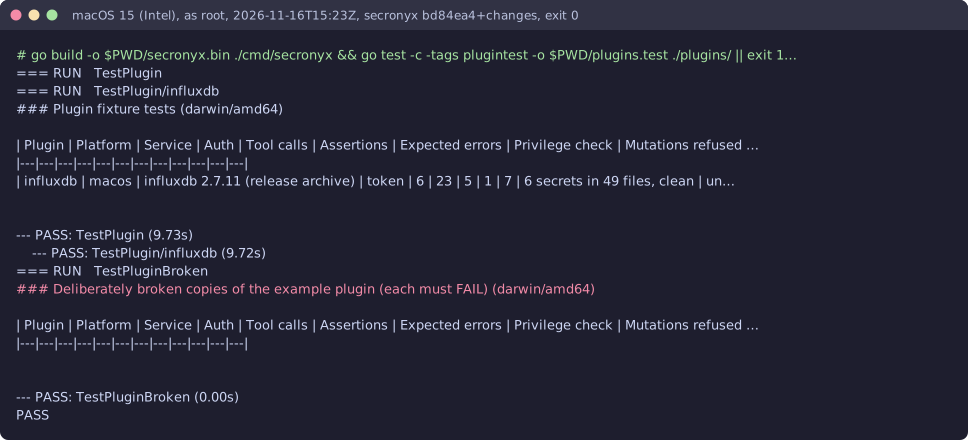
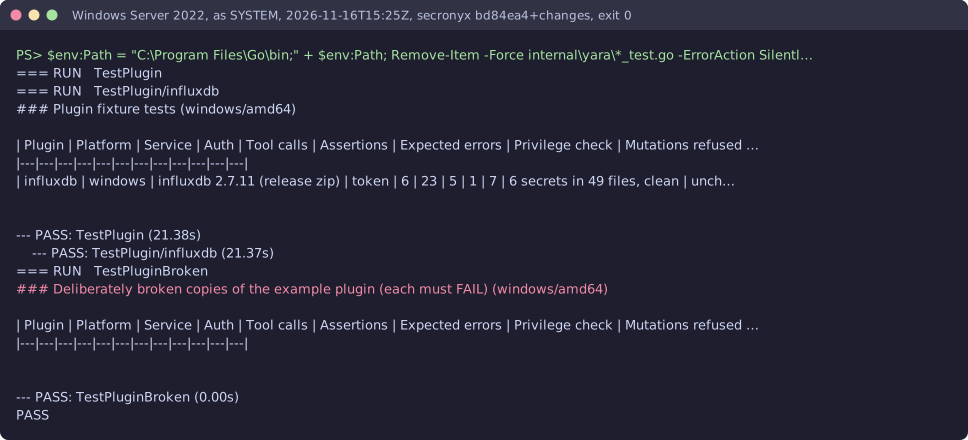
Read-only, in layers
Every request is a GET or HEAD to the endpoint the operator configured, on a path fixed in the signed pack. Redirects are not followed, and requests known to change state are refused.
These controls narrow what the plugin can do; none of them is a guarantee on its own. An administrator can still accept a more powerful login on purpose (audited and shown in status), root or Administrator on the host can replace the agent, and the plugin can read whatever its login can see.