Apache Pulsar
See what a Pulsar broker serves, which topics hold the most backlog and which subscriptions are behind, without consumers or blocked, from the broker's metrics, with a token for a role that is granted nothing. This plugin is in the next Secronyx release; the current download does not include it yet.
What it answers
Questions an on-call engineer asks, which an AI client can answer with this plugin.
- Which topics on this broker have the largest backlog, in entries and bytes?
- Which subscription is behind, and does it have any consumers connected?
- Is a subscription blocked on unacknowledged messages, or are its messages expiring?
- How many topics, producers and consumers does the broker serve, and at what message rate?
- Did the broker restart, and how close is it to its direct memory limit?
What it returns
Each of the plugin's read-only tools, described in words.
- The Pulsar broker this agent reads, one row - version, start time, the topics, subscriptions, producers and consumers it serves, message rates, stored bytes, backlog, connections and direct memory
- Pulsar topics this broker serves, the largest backlog first - backlog in entries and bytes, stored bytes, message rates in and out, and the count of subscriptions, producers and consumers
- Pulsar subscriptions on this broker, the largest backlog first - backlog in entries, unacknowledged messages, whether dispatch is blocked on them, delayed messages, consumers and rates out
At a glance
- Plugin
- pulsar 1.0.0
- Publisher
- levantar
- Platforms
- Linux
Tested on
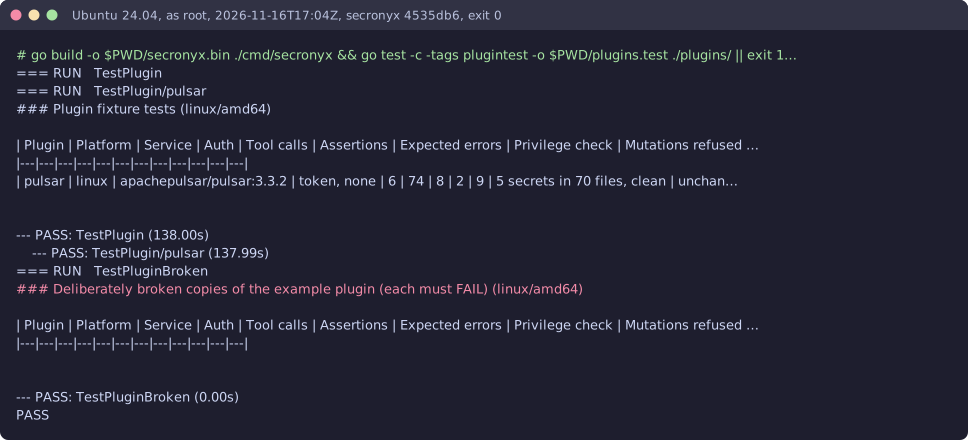
- Apache Pulsar 3.3.2 standalone on Linux (Ubuntu 24.04, Docker), test lab
How it logs in
Without an explicit choice, install tries the methods that need no secret first, in this order.
- A bearer token
- No login (a local endpoint)
The least-privilege login
The setup file in the pack. secronyx plugin setup pulsar prints it; an administrator applies it by hand.
See it run
Read-only, in layers
Every request is a GET or HEAD to the endpoint the operator configured, on a path fixed in the signed pack. Redirects are not followed, and requests known to change state are refused.
These controls narrow what the plugin can do; none of them is a guarantee on its own. An administrator can still accept a more powerful login on purpose (audited and shown in status), root or Administrator on the host can replace the agent, and the plugin can read whatever its login can see.