AWS DevOps Agent investigates with Secronyx
AWS DevOps Agent looks inside the servers through Secronyx's read-only checks and traces a filling disk to a deleted log file still held open.
The scenario
Three EC2 instances ran Secronyx: web-1 and web-2, the web tier, and a database host labelled as holding card data. On web-1 a stand-in service, orders-api, kept writing to a log file that log rotation had already deleted, so the space was still used but the file no longer had a name. Every directory looked small.
The alert
Grafana fired when web-1's root filesystem fell below 25% free. Each alert goes to AWS DevOps Agent, which has the commander registered as a single MCP server, and to the Secronyx Grafana bridge, which runs a fixed check of its own and keeps signed evidence.
At a glance
Grafana fires: web-1's root filesystem is below 25% free
AWS DevOps Agent opens an investigation in the same second
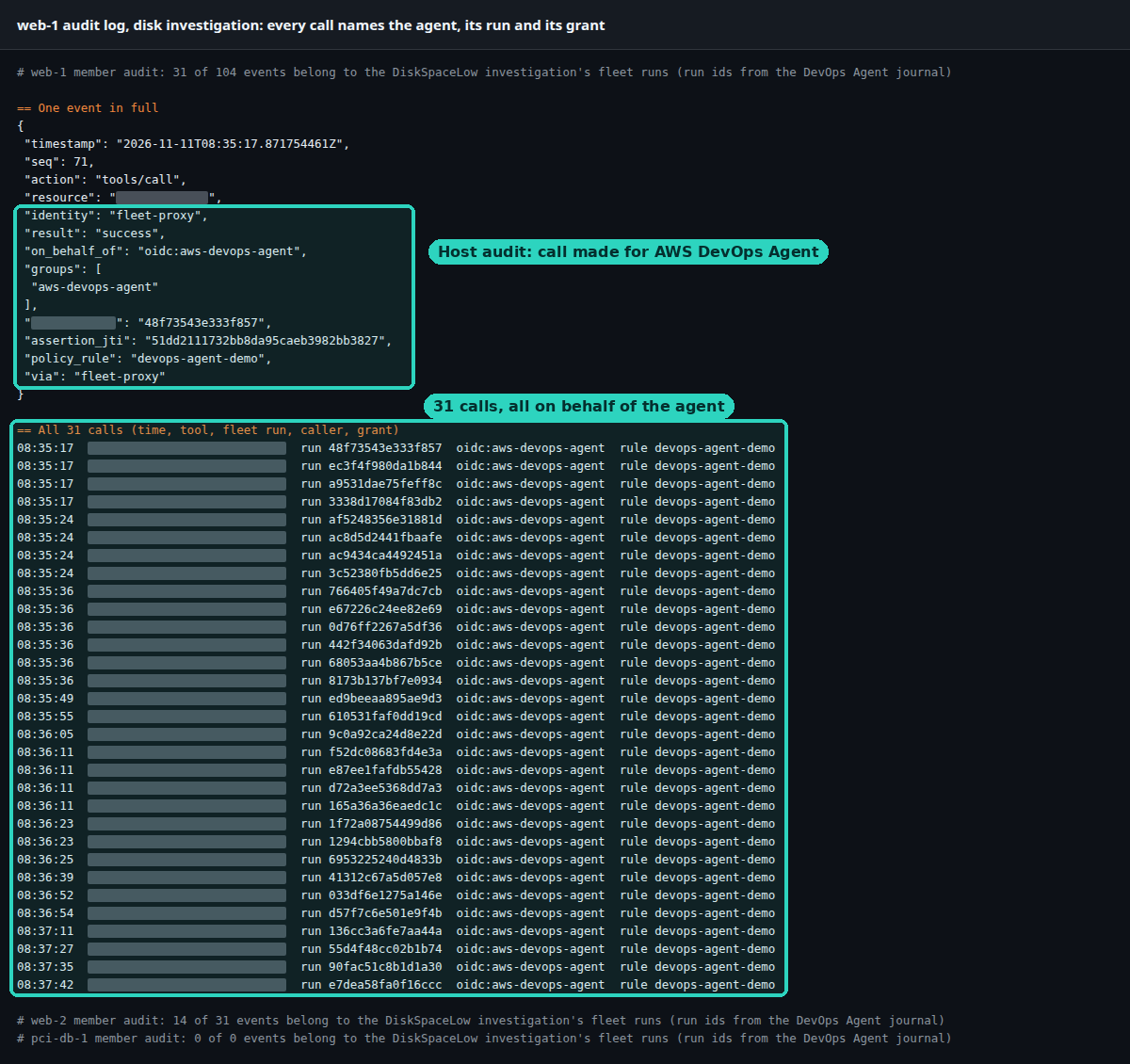
The agent calls Secronyx 41 times, comparing web-1 with web-2
It traces 4.9 GiB to a deleted log file held open by orders-api
It proposes a fix for a person to apply, and applies nothing
What Secronyx gathered, and how it was restricted
What it gathered from the host
- Disk and filesystem usage
- Open files, including deleted files still held open by a running service
- Services, processes and configuration, such as the log rotation rule
- The same checks on the healthy twin host, for comparison
How it was restricted
- Fixed read-only checks: none changes a host or returns file contents, and the agent keeps its read-only role
- A label policy decides which hosts the agent may see; the card-data host is missing from its host list
- Before a host runs anything, it checks a single-use pass signed by the commander, naming the caller and the rule that allowed the call
- Every call is in the answering host's own audit log, with the agent, its run and the rule that allowed it
- Results are signed by the host and verify offline
What the AI concluded
AWS DevOps Agent reported that orders-api was holding open a deleted 4.9 GiB log file, which explained about 98% of the extra space web-1 used compared with web-2. It found the rotation rule that caused it, noticed web-2 has the same bug on a smaller scale, and flagged a configuration change only on web-1 as the likely trigger but unconfirmed. When asked to check the card-data host it got zero hosts back and reported it as unchecked, not clean.
The proof
Figures from the recorded run, as reported in the walkthrough.
41 calls
to Secronyx in under three minutes, with nobody steering
4 min 9 s
from alert to root cause
28 findings
in the disk evidence case, verified offline
0 hosts
returned when the agent was asked to check the card-data host
See every step
The walkthrough has the setup, the full story with screenshots, the evidence and how to run it yourself. Read the full run log
Product names belong to their owners and are used only to say what each demo connects to. Secronyx is not affiliated with, sponsored or endorsed by them.