MinIO
See how many MinIO nodes and drives are offline, how much space is left, which erasure set is closest to losing write quorum and which drive is failing, from its metrics with a metrics-only login. This plugin is in the next Secronyx release; the current download does not include it yet.
What it answers
Questions an on-call engineer asks, which an AI client can answer with this plugin.
- How many MinIO drives and nodes are offline right now?
- How much raw and usable space does the cluster have left?
- Has any erasure set lost write quorum, and how many more drives can each set lose?
- Which drive on this node is offline, healing or almost full?
- Which drive is returning timeout or I/O errors?
What it returns
Each of the plugin's read-only tools, described in words.
- MinIO cluster health in one row - nodes and drives online and offline, the drive count, and raw and usable capacity with what is free
- MinIO erasure sets, one row per pool and set - health, read and write quorum, drives online and healing, and how many more drives each set can lose before reads or writes stop
- MinIO drives of this node that it can reach, one row each - path, pool and set, state (1 ok, 2 healing, 0 offline), bytes and inodes used and free, error counters and waiting I/O
At a glance
- Plugin
- minio 1.0.0
- Publisher
- levantar
- Platforms
- Linux, Windows, macOS
Tested on
- MinIO RELEASE.2025-10-15T17-29-55Z (built from source) on Linux (Ubuntu 24.04, Docker), test lab
- MinIO RELEASE.2025-10-15T17-29-55Z (built from source) on macOS 15 (Intel), test lab
- MinIO RELEASE.2025-10-15T17-29-55Z (built from source) on Windows Server 2022, test lab
How it logs in
Without an explicit choice, install tries the methods that need no secret first, in this order.
- A bearer token
- No login (a local endpoint)
The least-privilege login
The setup file in the pack. secronyx plugin setup minio prints it; an administrator applies it by hand.
See it run
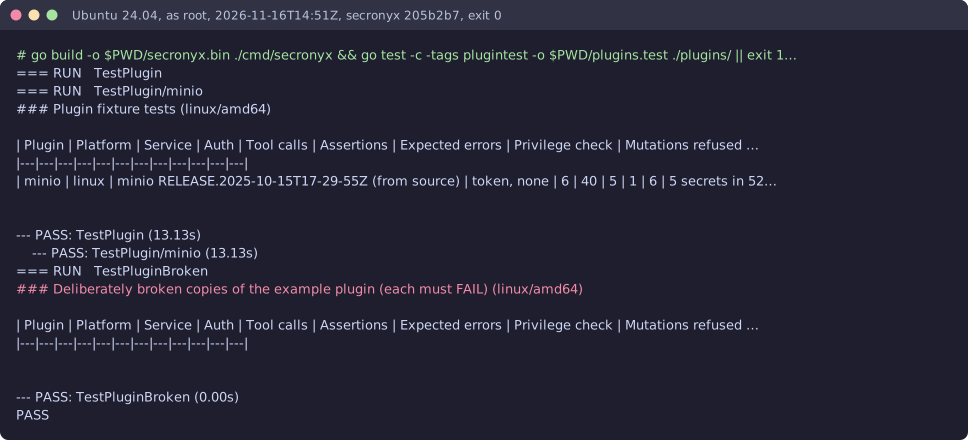
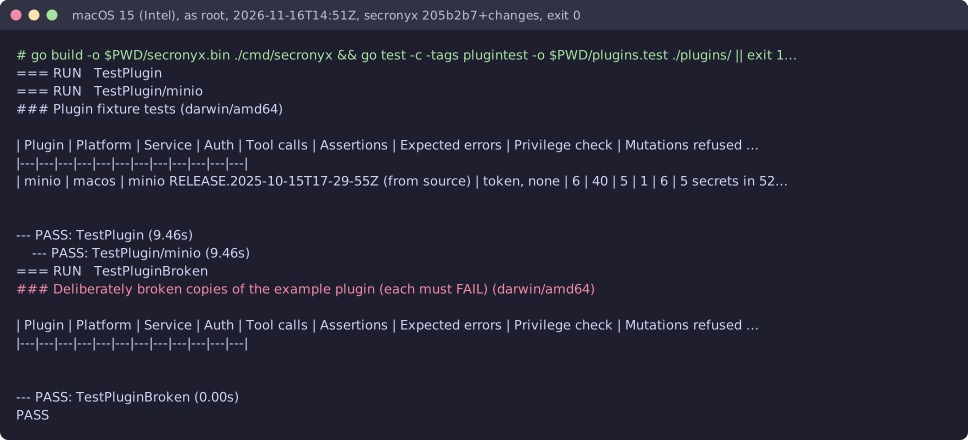
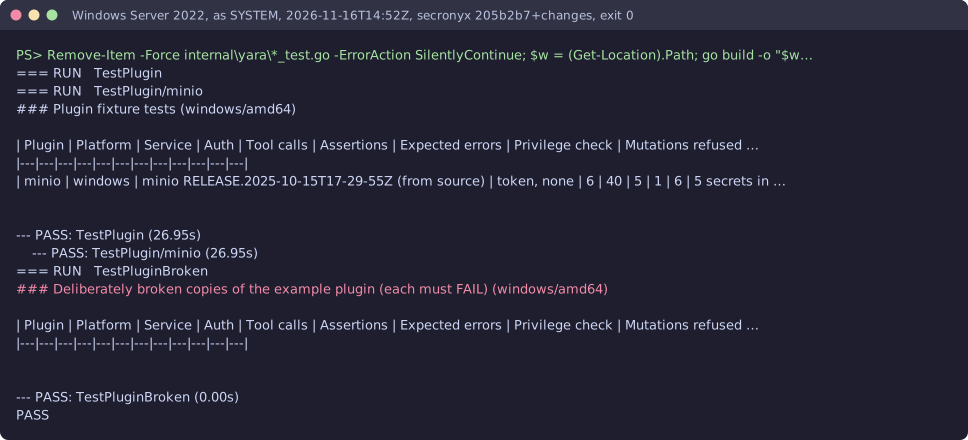
Read-only, in layers
Every request is a GET or HEAD to the endpoint the operator configured, on a path fixed in the signed pack. Redirects are not followed, and requests known to change state are refused.
These controls narrow what the plugin can do; none of them is a guarantee on its own. An administrator can still accept a more powerful login on purpose (audited and shown in status), root or Administrator on the host can replace the agent, and the plugin can read whatever its login can see.